Karen Rose Thomas, a northwest coast hybrid, living and loving in British Columbia Canada. I am a proud Coast Salish woman - passionate about archaeology, decolonizing methodologies and Indigenous mothering. Thoughts and words are my own unless otherwise noted.
Today, I’m planning to do the same thing I strive for every day, although a bit more intentionally. It started off waking up at 6:05, like every day, but I didn’t get out of bed right away.
I whispered truths to my co-sleeping child about how smart, funny, kind and brave he is. I thanked him for choosing me to be his mama. I thought about my absolute privilege to be an Indigenous mother in 2025, and the beauty in filling my children up with goodness.
I laid in bed a bit longer, before getting up to make coffee, and starting peach cobbler that 2/3 children enjoy (the third eats cheerios, banana and milk every day).
I’m just going to be slow and intentional today, me: a little love light burning for all Indigenous people and mothers and children fighting for sovereignty and the ancestors by existing, thriving, loving and living.
Each moment with my children today will be an intentional prayer for every child who never made it home, and for those parents and communities who miss them, past and present.
Colonialism is system operating as intended, that Canadians continue to uphold and benefit from. I think today is simultaneously important and also at the same time a shallow, topical non-solution.
Just thought you should know. I’m wrapping up my second year, completed all my course work, working on my hən̓q̓əmin̓əm̓, ʔəy̓ tə nə šxʷqʷeləwən. Hopefully I will write my comprehensive exams in September and defend my research proposal in October.
I’m going to do a little series of letters to authors in response to my comprehensive exam reading lists, but only *after* my exams are finished.
I’m struggling a bit, when everything feels important, trying to balance the desire to capture all essential information with the desire to rush through and complete the product (my annotations).
Regardless of my emotional state and the crazy shit going down in the world, I’m working hard to hold on to the fact that I am incredibly privileged to be working on my own research nestled within my community.
My inner child is a tender heart. She has a foot in two realms: reality and reality, too.
She loves recklessly and impulsively, often without prejudice and has sometimes loved without the consent of her lovees and lovers.
My inner child has a tender heart, a raw gaping wound, chafed. She is an emotional masochist, and everything she has and has had she manifested with me.
Co-creating our realities with a benevolent universe, ie. working our asses off to build a dream. My inner child is a tender heart who never learns a lesson and still she has a lot to teach me.
***These are my own thoughts I’m working through on this topic, and I have a lot of thoughts on “traditional” and “authentic” that aren’t in this post. Still: BIG. LONG thoughts ahead.
I love love and I love Uncle Dan’s words here and I feel the love while reading them. My mom said in her post “wrapped in blankets of love,” and I feel it and treasure that feeling. ♡
The only thing I would add is that while Indigenous peoples were irreparably affected by contact, and while settlers have changed the course of Indigenous life in immeasurable ways, we continue to protect and uphold our values and laws. I don’t think it is as simple as it was thought of in the past. I don’t think that taking up elements and values (the good ones) of settler and now mainstream Canadian society necessarily means that we need to put down our Indigenous values. No place here for an extensive discussion of that period in time between 1884 and 1951 (and the effects of that time) when spirituality and ceremony and gathering were illegal under the Indian act.
If anything, I feel like when non-indigenous people complain that we are not “traditional” for driving cars or using electricity or whatever droll argument, they forget of our most “traditional traditions,” INNOVATION and ADAPTATION.
Our Ancestors were masters at effective adaption, and so are we. Archaeology has shown me this in a myriad of ways, the Indigenous presence on these lands is a deep deep catalogue of evidence of adaption. Innovation and adaption so wonderous that thousands of stuffy academics (sorry friends reading this 😅) have found the records of our Indigenous Ancestors fascinating. Enough so, that they have dedicated years (sometimes decades) of their lives learning to read the story of the land in their own ways.
Our resilience is showing, cousins. Look at the youth, showing how easy it is to pick up the pieces of settler culture and carry them forward, without putting down the old ways they are rejuvenating.
I should stop now, I think this is a paper but I’ve invested too much time in this post to delete it now! Hahaaaaa. Love.
I am a native of North America – Chief Dan George, from My Heart Soars
In the course of my lifetime I have lived in two distinct cultures. I was born into a culture that lived in communal houses. My grandfather’s house was eighty feet long. It was called a smoke house, and it stood down by the beach along the inlet. All my grandfather’s sons and their families lived in this dwelling. Their sleeping apartments were separated by blankets made of bull rush weeds, but one open fire in the middle served the cooking needs of all. In houses like these, throughout the tribe, people learned to live with one another; learned to respect the rights of one another. And children shared the thoughts of the adult world and found themselves surrounded by aunts and uncles and cousins who loved them and did not threaten them. My father was born in such a house and learned from infancy how to love people and be at home with them.
And beyond this acceptance of one another there was a deep respect for everything in nature that surrounded them. My father loved the earth and all its creatures. The earth was his second mother. The earth and everything it contained was a gift from See-see-am…and the way to thank this great spirit was to use his gifts with respect.
I remember, as a little boy, fishing with him up Indian River and I can still see him as the sun rose above the mountain top in the early morning…I can see him standing by the water’s edge with his arms raised above his head while he softly moaned…”Thank you, thank you.” It left a deep impression on my young mind.
And I shall never forget his disappointment when once he caught me gaffing for fish “just for the fun of it.” “My son” he said, “The Great Spirit gave you those fish to be your brothers, to feed you when you are hungry. You must respect them. You must not kill them just for the fun of it.”
This then was the culture I was born into and for some years the only one I really knew or tasted. This is why I find it hard to accept many of the things I see around me. I see people living in smoke houses hundreds of times bigger than the one I knew. But the people in one apartment do not even know the people in the next and care less about them.
It is also difficult for me to understand the deep hate that exists among people. It is hard to understand a culture that justifies the killing of millions in past wars, and it at this very moment preparing bombs to kill even greater numbers. It is hard for me to understand a culture that spends more on wars and weapons to kill, than it does on education and welfare to help and develop.
It is hard for me to understand a culture that not only hates and fights his brothers but even attacks nature and abuses her. I see my white brothers going about blotting out nature from his cities. I see him strip the hills bare, leaving ugly wounds on the face of mountains. I see him tearing things from the bosom of mother earth as though she were a monster, who refused to share her treasures with him. I see him throw poison in the waters, indifferent to the life he kills there; and he chokes the air with deadly fumes.
My white brother does many things well for he is more clever than my people but I wonder if he has ever really learned to love at all. Perhaps he only loves the things that are outside and beyond him. And this is, of course, not love at all, for man must love all creation or he will love none of it. Man must love fully or he will become the lowest of the animals. It is the power to love that makes him the greatest of them all…for he alone of all animals is capable of love.
Love is something you and I must have.
We must have it because our spirit feeds upon it. We must have it because without it we become weak and faint. Without love our self esteem weakens. Without it our courage fails. Without love we can no longer look out confidently at the world. Instead we turn inwardly and begin to feed upon our own personalities and little by little we destroy ourselves.
You and I need the strength and joy that comes from knowing that we are loved. With it we are creative. With it we march tirelessly. With it, and with it alone, we are able to sacrifice for others.
There have been times when we all wanted so desperately to feel a reassuring hand upon us…there have been lonely times when we so wanted a strong arm around us…I cannot tell you how deeply I miss my wife’s presence when I return from a trip. Her love was my greatest joy, my strength, my greatest blessing. I am afraid my culture has little to offer yours. But my culture did prize friendship and companionship. It did not look on privacy as a thing to be clung to, for privacy builds walls and walls promote distrust. My culture lived in a big family community, and from infancy people learned to live with others.
My culture did not prize the hoarding of private possessions, in fact, to hoard was a shameful thing to do among my people. The Indian looked on all things in nature as belonging to him and he expected to share them with others and to take only what he needed.
Everyone likes to give as well as receive. No one wishes only to receive all the time. We have taken something from your culture…I wish you had taken something from our culture…for there were some beautiful and good things in it.
Soon it will be too late to know my culture, for integration is upon us and soon we will have no values but yours. Already many of our young people have forgotten the old ways. And many have been shamed of their Indian ways by scorn and ridicule. My culture is like a wounded deer that has crawled away into the forest to bleed and die alone.
The only thing that can truly help us is genuine love. You must truly love, be patient with us and share with us. And we must love you—with a genuine love that forgives and forgets…a love that gives the terrible sufferings your culture brought ours when it swept over us like a wave crashing along a beach…with a love that forgets and lifts up its head and sees in your eyes an answering love of trust and acceptance.
This is brotherhood…anything less is not worthy of the name. I have spoken.
I’ve been thinking about memory lately, trying to hold onto every shred of baby time with the 3rd and last small human of my creation. Memory is fleeting, fickle, finite. My memories are unique to my perspective, and I filter them through my present lense as much as I shaped them with the filter of my past thoughts and emotions.
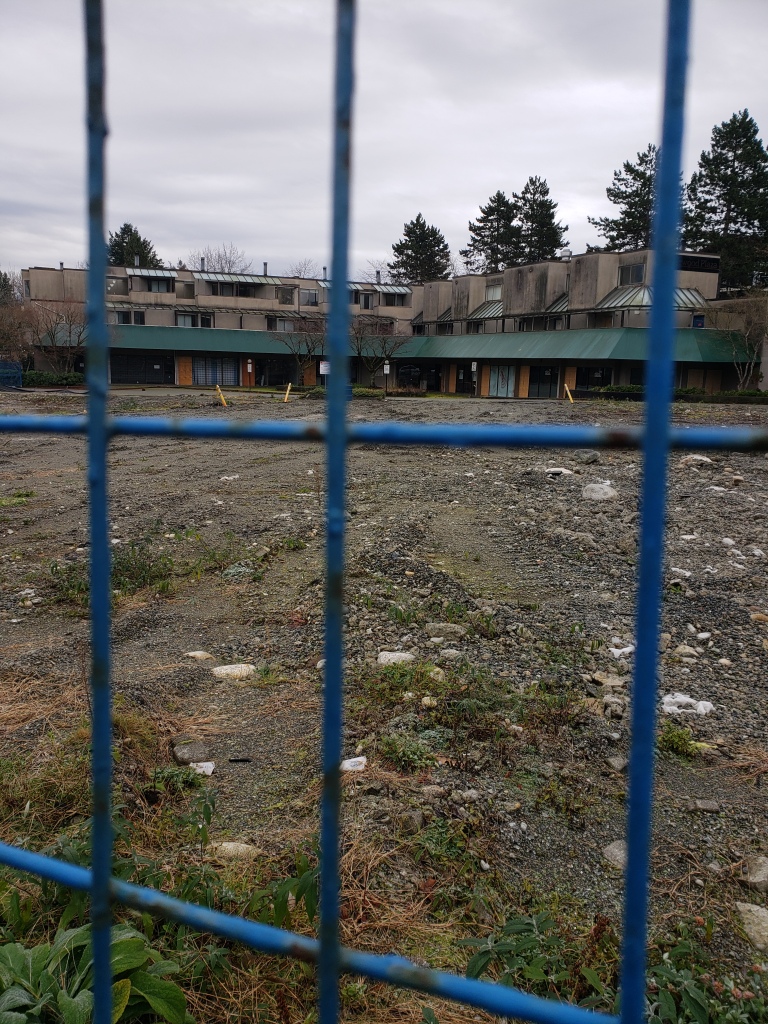
Maplewood Plaza, December 2021
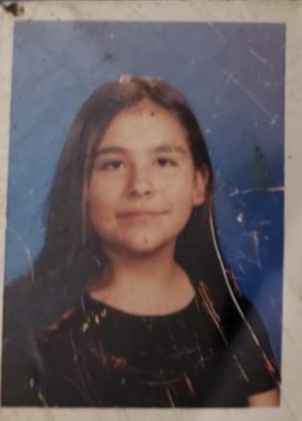
I felt a memory here. My mother and my aunt, there may have been other people there too. Lionel was my aunt’s boyfriend and he lived in these apartments. There was a Panago downstairs, but it was probably still called Panagopolous. I think I am 10 years old, maybe 9. We had pizza and the adults were drinking. My aunt was in rare form, a kind and jovial drunk, instead of the sharp and suspicious angry drunk she mostly was.
“Who loves you, Baby?” She said that night, pulling me into a rare embrace. “Who loves you, Baby?”
“Who loves you, Baby?”
“You do, Auntie,” I replied, not sure if it was the correct answer. I remember her face, large pores, the lines around her eyes when she smiled, the feathered bangs parted strictly and framing her forehead. The smell of cigarettes, beer, sweat and men’s deodorant because she refused anything soft and sweet smelling. She was strong and took no shit. She was an unintentional Indigenous feminist.
“Who loves you, Baby?” And I thought it was just a simple, rhetorical question. She said it to me on several other occasions, her affectionate expression. Sifting through these moments of memory inspired by place, I think maybe the question was more. Physical affection for kids in my family was rare. I hugged my mother once a week, before I left to go to my dad’s house. Love was unacknowledged but often conditional.
Probably “Who loves you, Baby?” Was the easiest way for her to say “I love you,” without the absolute commitment. I wonder what terms of affection my IRS survivor grandparents offered their children. I have no one to ask because my mom would never answer.
Thinking through this and realizing that announcing my love to my children has more meaning, is a proclamation, feels very definitive. “I love you.” Me. Mama. I love you. No doubts, no conditions. No alcohol obscuring my intergenerational trauma. I’m here feeling it. Loving all of you.
“Ontological insecurity refers, in an existential sense, to a person’s sense of “being” in the world. An ontologically insecure person does not accept at a fundamental level the reality or existence of things, themselves, and others. In contrast, the ontologically secure person has a stable and unquestioned sense of self and of his or her place in the world in relation to other people and objects.” (Jackson & Hogg, 2010)
So yes. The passing of years is a comfortable constant. Life delights me daily when the sun warms my flesh and the wind brushes my hair out of my face or the rain joins my tears, both the visible and the spiritual. When I feel tired, I take off my shoes and I squish my toes in the grass. The grounding energy of the earth energizes me.
Life is a miracle that sometimes I take for granted, caught up in feeling the feelings as deeply as I do. Feeling is the uncanny power I possess. I feel deeply and ruthlessly and more than normal. I fall in love with a senselessness, an easy empty headed joy; as easy as loving a breeze on a hot day, or sticky sandy hugs from a toddler. I love roses and orchids and berries and the sacred geometry of all plants. I love the provocative nature of bees and sexy flowers and the miracles of tasty fruit.
The benefits of loving this life are found in my family and also in the friends that I have manifested, for moments or years or lifetimes, friends I haven’t met yet, friends with whom I nurture varying degrees of intimacy. In addition to my physical village, I have a larger digital village which I am also thankful for.
The freedom of being uniquely me makes me feel at home in the world. The ability to do exactly what I dream of everyday. That I can manifest the blessings to combat the sorrows. That I challenge dominant discourses simply by existing, by “doing” me. The electric shock of communing with my Ancestors through their material culture which is not intangible. Looking into the sky to see eagles waiting, allowing me to witness their playful sky dance. Soft sighs of “mama” in the night. These things nourish me, and my ontological security.
Thanks, if you’re reading, for all you do everyday, for being you.
My Grandma Margaret loved to crochet. She taught me when I was young and she let me dig around in her yarn and craft supplies and I loved her for it. She also taught me to read patterns. She had patterns that she recieved handed down from Auntie Cassie, and she’d tell me about how Cassie didn’t read patterns, but a magnifying glass to count stitches. When Cassie was done she’d give them to my gramma who would follow the patterns and she marveled at. These pattern books are from the 80s and 90s.
Next, my Grandma would always rip the free patterns at the yarn stores, usually taking 2 or three. When I would visit, she’d make me sort them, take copies I wanted and pile up the doubles for her so she could redistribute in her networks. Here is my accumulation.
The American Miniaturist belonged to my Grandma Raylene. She made miniatures, was in miniature clubs, and had friends all over the pacific northwest who also enjoyed this hobby. She too had a redistribution network, and I was often the final destination for some of these hobby magazines.
Somewhy I curated these things together in one place.
As an Indigenous archaeologist studying the lifeways of the ancestors through their material culture, I get embroiled in long drawn out thoughts about sensorality, life/thought energy and materiality in Ancestral objects and assemblages.
This collection is a present/future Ancestral assemblage. By curating these things together, in combination with my thoughts and memories about them, I have added my energy to the assemblage. I have cared for them for 15-25 years already.
Also present in the assemblage is a memory of each moment there was energy contact between people’s attention and the objects, and here in my reasoning I draw on Yannis Hamilakas’ work with sensorial assemblages.
I think when I extrapolate the ideas to apply to Ancestral assemblages of stone tools. I tend to reinterpret with my Xwelmuxw lenses to imagine all who have given the thoughts about the objects energy to be included in an assemblage, Ancestors witnessing stone tools; stone tools witnessing Ancestors; both stone tools and Ancestors witnessing me witnessing them.
Maybe when we die, our energy is just scattered, across everything we’ve ever held in our attention, objects and energy we have engaged or interacted with. And it remains there, forevermore, for connection with future moments.
Sometimes I wonder how I can simultaneously be so attached to this plane/terrified to physically leave it and the love I have here and also feel so confident that whatever is next is okay too. Mind boggling…
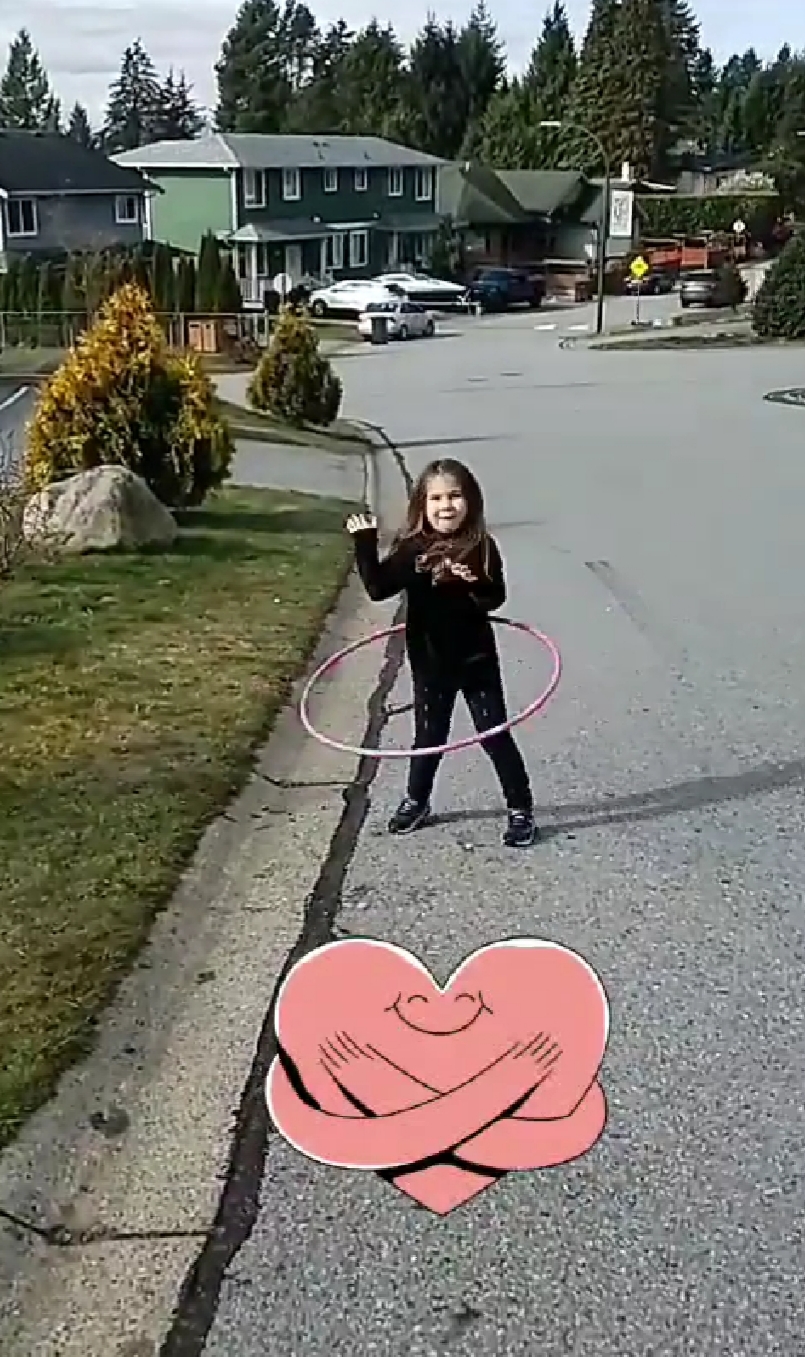
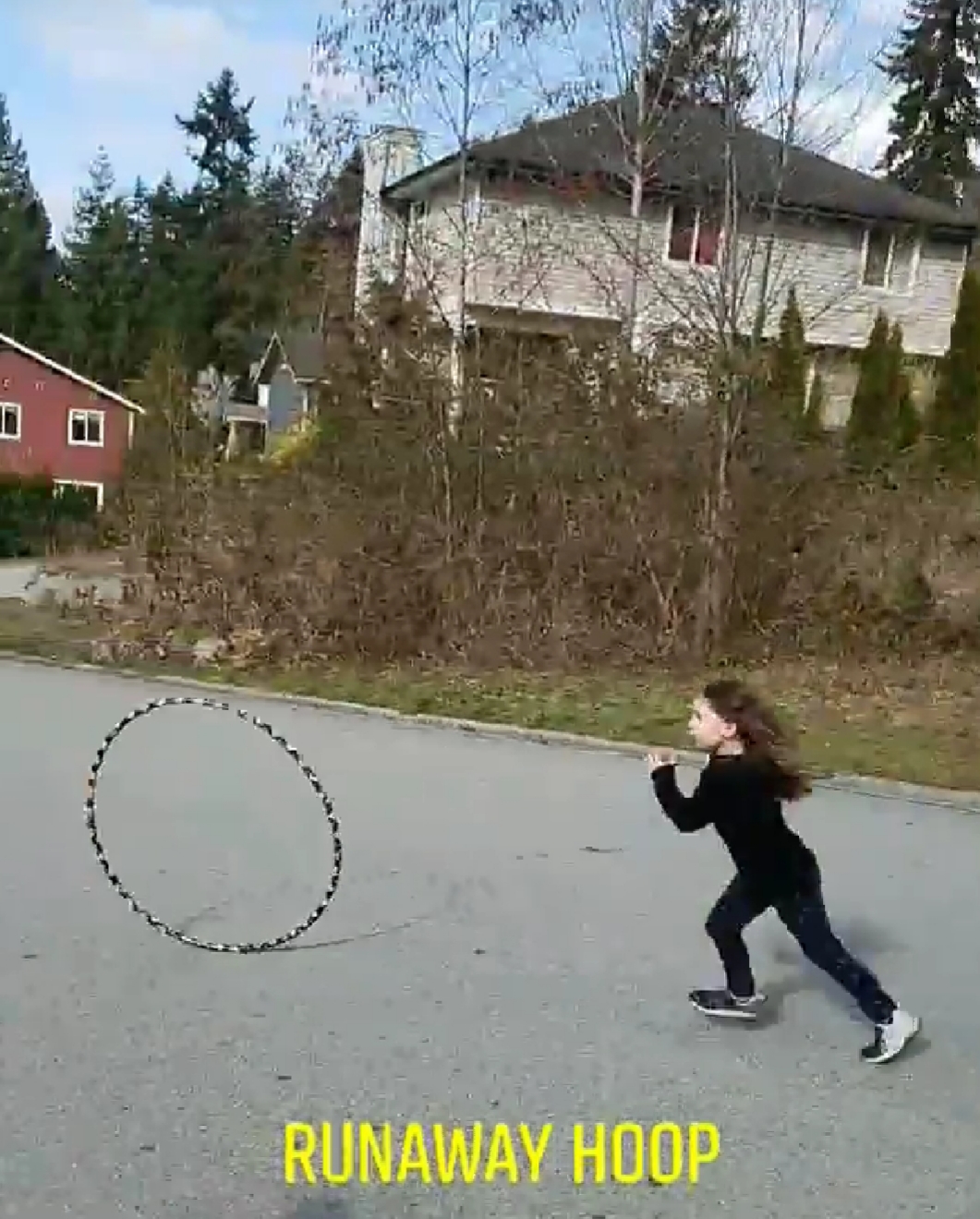
We ate breakfast and then went outside to hoolahoop. In these weird, stressful and completely absurd times, (STOP SAYING UNPRECEDENTED, it’s annoying!) moving the body helps. We don’t need to be couch potatoes, we can maintain a social distance, no one is out as early as us anyway!
Phae can keep it up for about 45 seconds, while Fox had fun chasing a hoop around the parking lot. I am a bit rusty, but I impressed the kids and the neighbours with my pre-child hoolahooping skills, hahaha. The day revolved around meals and snacks. We put away laundry, it felt like an achievement. Phae and I did origami while Fox napped, she chooses complicated projects and I make them.
Origami has actually been a great distraction, in that it is a tiny momentary exercise in trust and faith, where I can surrender to outside instructions and have them work out as something cool and constructive and of value. Such a weird metaphor, I know. Today I made a little stationary storage multi-level box (Phae’s choice), a cactus in a pot, a diamond, a star and some weird triangle boxes with Tony.
We had an awkward conversation where I was frustrated with him about his choices with working. Like, he has some weird, patriarchy hang-up that AS A MAN, he needs to be working. If he was worried about money, I make more, but we’re certainly not going to argue about whose job is more important. In the face of a global pandemic, neither seems very essential. The job that is important is parenting, the kids need to be loved. I am the motherish, default primary parent and I am actively trying to choose connection. I am trying to surrender my capitalist slave mentality to just be present with my children and do some child-led and place based learning.
In our present reality while earth is in the throes of a global pandemic, “real archaeology” (whatever that is), shitty settler developers, anthropology, my masters degree, it all seems pretty fucking inconsequential.
I love the land and the Ancestors, but I don’t really like my job, and it seems so fucking skewed to put the job before my family. I am letting the work at home stuff stress me out, and I’m barely keeping on top of my work emails. If I could manage more, (while juggling children, cooking and planning every meal, rationing the food we have, budgeting and trying to keep the household somewhat not a sty) I wouldn’t be making much of a contribution to the discipline. Yes, let’s write a boiler plate report for some questionable settler development so they can check their archaeology box on the list of requirements issued by settler colonial governments for a permit to destroy/redestroy/disregard Indigenous cultural heritage and territory.
So I worked my ass off for 8 years in post-secondary to get a couple of degrees, yay I achieved a couple of things valued by a few segments of settler society. I made many sacrifices to do it. I fucking did it. I joke about being the reluctant anthropologist, but truth be told, anthropology has ruined me.
“My journey through this degree has dragged me through the ongoing tragedy of settler colonialism, the fatalism of salvage ethnography and the stark whiteness of early feminist anthropology. It has also allowed me to revel in fantastical works of Indigenous scholarship and led me to appreciate the value of anthropology to archaeology for illuminating the people behind the objects. My growth is a work in progress. I am a reluctant anthropologist.”
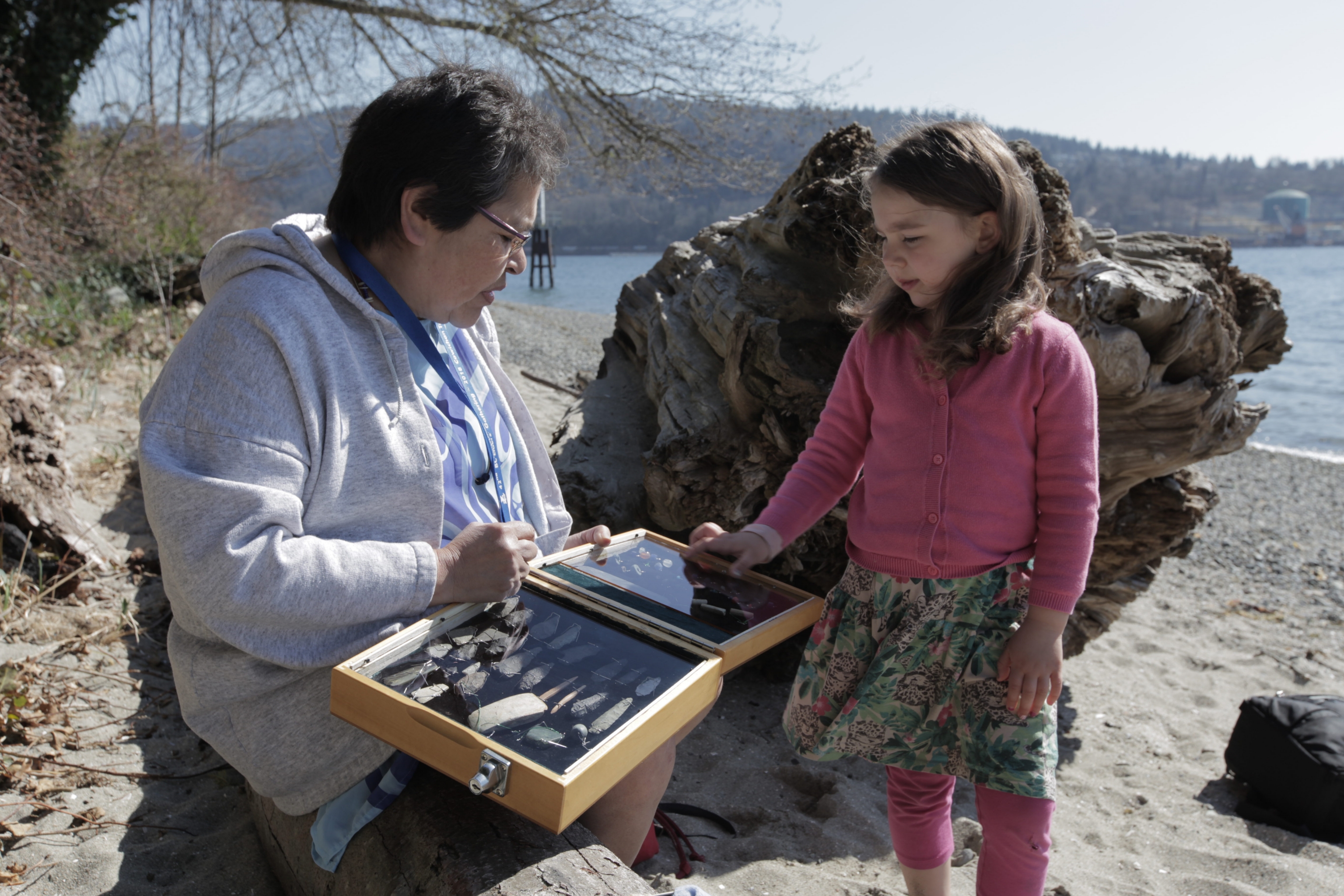
So I agreed to help some students out from the Reporting in Indigenous Communities class at UBC school of journalism. This is their end product, and while I feel bashful about it, I am very proud of them! They make me sound smart, Haha! They also took some wonderful pics of my mom and my kids ♡ my CBC debut
We talk decolonizing archaeology as innovation and colonial grad school woes.







 The Reluctant Anthropologist